
Featured Resources
-
As classroom technology and generative AI evolve at breakneck speeds, education leaders face a critical choice: rely on flashy, general-consumer tools or invest in secure, purpose-built infrastructure. The Project Unicorn Q2 Brief cuts through the digital noise to show why robust data standards, modernized data architecture, and evidence-based procurement are the ultimate guardrails for student safety and academic success.
Download the Q2 Interoperability Brief to equip your leadership, technology, and procurement teams with the standards-based toolkits, rubrics, and templates needed to build a safe, future-ready digital ecosystem.
-
2026 Quarter 1 AI & Interoperability Brief Release
Interoperability is foundational to AI success in education, and building an underlying structure grounded in data standards and data maturity is key to implementing AI that will truly benefit schools and students.
The 2026 Quarterly AI and Interoperability Brief Series explores the intersection of interoperability and AI, highlighting the latest trends, case studies, and tools you can use to improve your educational technology ecosystem.
-
Currently, the lack of standardized, national definitions for core service terms creates a systemic ‘transfer gap.’ This lack of clarity often results in significant delays for students waiting to receive comparable services in a new district. To address this, researchers convened an expert panel to establish a much-needed consensus on these terms.
-
AI Data Use and Protection - Worksheet
In the rush to adopt an AI tool, don’t let data security become an afterthought. The AI Data Use and Protection Worksheet is designed to help cross-functional leaders—from the CISO to General Counsel—a clear, standardized vetting process.
This worksheet allows teams to create a side-by-side risk matrix for every vendor, allowing them to make a safe, confident, and informed decision before entering a vendor agreement.
-
Considerations for the School Districts in Considering Large Scale AI Model Deals
As Artificial Intelligence (AI) and frontier AI models rapidly reshape the educational landscape, school systems face a dual challenge: harnessing these tools' transformative potential while rigorously safeguarding student data, privacy, and well-being. Procurement is no longer just about purchasing; along with AI literacy, it is the first line of defense in responsible AI governance.
The following slide deck is available for consideration and understanding.
-
Considerations for the School Districts in Considering Large Scale AI Model Deals
As Artificial Intelligence (AI) and frontier AI models rapidly reshape the educational landscape, school systems face a dual challenge: harnessing these tools' transformative potential while rigorously safeguarding student data, privacy, and well-being. Procurement is no longer just about purchasing; along with AI literacy, it is the first line of defense in responsible AI governance.
For years, Project Unicorn has championed the need for data to flow seamlessly and securely between systems to inform instruction and operations. Simultaneously, the EDSAFE AI Alliance has led the global charge on the SAFE (Safety, Accountability, Fairness, and Efficacy) benchmarks for AI adoption in education.
Now, as "frontier models"—highly capable, large-scale AI systems—enter our schools, these two missions must converge. Procurement is the intersection where safety meets connectivity.
We developed this resource to bridge the gap between technical data governance and ethical AI implementation, responding to practical needs from our work leading 29 school district policy labs and 10 state policy labs. These questions are designed to help district and state leadership vet tools not just for what they can do, but for how they fit into a secure, interoperable, and learner-centered ecosystem. Whether you are evaluating a standalone AI app or integrating a large-scale frontier model, this guide can be part of your blueprint for responsible innovation.
Resource Database

Data Integrator List
Data integration platforms, products and services can help school systems seamlessly and securely bring together previously siloed education data, supporting advanced data analytics and reporting. This can help educators make better decisions to support students and save school systems time and money. Peruse our list of integration specialists to find the right provider and solutions for you!

First Three Steps for Edtech Startups
Are you a startup or early stage edtech company? Learn why data interoperability is so important in today's competitive market and how you can make it your market advantage. After all, what startup doesn't want to be a Unicorn? Read more below!
Using Multiple Data Standards for Education Data Interoperability
Data interoperability standards make possible the seamless, secure, and controlled exchange of data between applications. If you’re wondering “What’s the best data standard?” you may be asking the wrong question. Instead of thinking “what standards team should I pick” you should be thinking “what standards should I have on my team?” The answer will depend on the game that you’re trying to win. Read more below!
Achieving Interoperability Through the Cloud
Whoever told you to get your head out of the clouds was wrong! Now, more than ever, K12 school systems are expected to provide students and educators with seamless learning experiences powered by data interoperability, even while working remotely. Modernizing data infrastructure and migrating data systems to the cloud can help make this a reality.
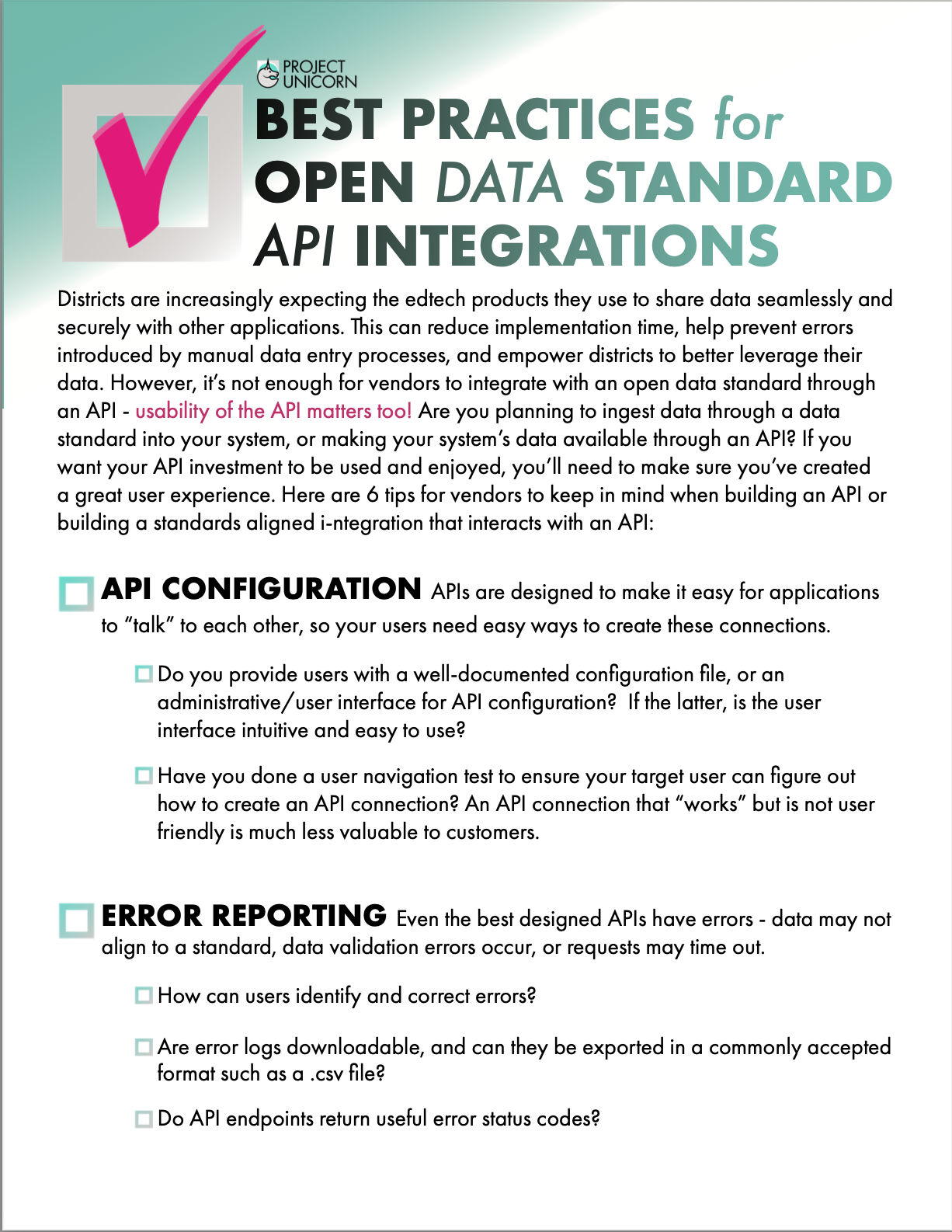
Best Practices for Open Data Standard API Integrations
Districts are increasingly expecting the edtech products they use to share data seamlessly and securely with other applications. This can reduce implementation time, help prevent errors introduced by manual data entry processes, and empower districts to better leverage their data. However, it’s not enough for vendors to integrate with an open data standard through an API - usability of the API matters too! Read more about best practices for open data standard API integrations.

Standards Certification Jump-Start Guide
Being certified to a data standard signals to customers that your product is truly interoperable. Certification gives buyers the confidence that their educational data will flow seamlessly and securely between their applications. Discover steps to certification for Ed-Fi Alliance, Access 4 Learning Community, and IMS Global here.
Data Myths and Misconceptions: Thoughts from the Project Unicorn Technical Advisory Committee
When it comes to data interoperability, sometimes it's hard to know what is fact and what is fiction. This resource tackles some of the most common myths and misconceptions about interoperability. Discover the truth with this resource from the Project Unicorn Technical Advisory Committee!

Interoperability Rubric
How does your school network rank? Review the rubric to assess your tier of interoperability.