
Featured Resources
-
As classroom technology and generative AI evolve at breakneck speeds, education leaders face a critical choice: rely on flashy, general-consumer tools or invest in secure, purpose-built infrastructure. The Project Unicorn Q2 Brief cuts through the digital noise to show why robust data standards, modernized data architecture, and evidence-based procurement are the ultimate guardrails for student safety and academic success.
Download the Q2 Interoperability Brief to equip your leadership, technology, and procurement teams with the standards-based toolkits, rubrics, and templates needed to build a safe, future-ready digital ecosystem.
-
2026 Quarter 1 AI & Interoperability Brief Release
Interoperability is foundational to AI success in education, and building an underlying structure grounded in data standards and data maturity is key to implementing AI that will truly benefit schools and students.
The 2026 Quarterly AI and Interoperability Brief Series explores the intersection of interoperability and AI, highlighting the latest trends, case studies, and tools you can use to improve your educational technology ecosystem.
-
Currently, the lack of standardized, national definitions for core service terms creates a systemic ‘transfer gap.’ This lack of clarity often results in significant delays for students waiting to receive comparable services in a new district. To address this, researchers convened an expert panel to establish a much-needed consensus on these terms.
-
AI Data Use and Protection - Worksheet
In the rush to adopt an AI tool, don’t let data security become an afterthought. The AI Data Use and Protection Worksheet is designed to help cross-functional leaders—from the CISO to General Counsel—a clear, standardized vetting process.
This worksheet allows teams to create a side-by-side risk matrix for every vendor, allowing them to make a safe, confident, and informed decision before entering a vendor agreement.
-
Considerations for the School Districts in Considering Large Scale AI Model Deals
As Artificial Intelligence (AI) and frontier AI models rapidly reshape the educational landscape, school systems face a dual challenge: harnessing these tools' transformative potential while rigorously safeguarding student data, privacy, and well-being. Procurement is no longer just about purchasing; along with AI literacy, it is the first line of defense in responsible AI governance.
The following slide deck is available for consideration and understanding.
-
Considerations for the School Districts in Considering Large Scale AI Model Deals
As Artificial Intelligence (AI) and frontier AI models rapidly reshape the educational landscape, school systems face a dual challenge: harnessing these tools' transformative potential while rigorously safeguarding student data, privacy, and well-being. Procurement is no longer just about purchasing; along with AI literacy, it is the first line of defense in responsible AI governance.
For years, Project Unicorn has championed the need for data to flow seamlessly and securely between systems to inform instruction and operations. Simultaneously, the EDSAFE AI Alliance has led the global charge on the SAFE (Safety, Accountability, Fairness, and Efficacy) benchmarks for AI adoption in education.
Now, as "frontier models"—highly capable, large-scale AI systems—enter our schools, these two missions must converge. Procurement is the intersection where safety meets connectivity.
We developed this resource to bridge the gap between technical data governance and ethical AI implementation, responding to practical needs from our work leading 29 school district policy labs and 10 state policy labs. These questions are designed to help district and state leadership vet tools not just for what they can do, but for how they fit into a secure, interoperable, and learner-centered ecosystem. Whether you are evaluating a standalone AI app or integrating a large-scale frontier model, this guide can be part of your blueprint for responsible innovation.
Resource Database

Better Edtech Buying: A Practical Guide - Revised Edition
To provide more insight and guidance into how edtech purchasing happens and consider how educators and leaders can work together to make more informed purchasing decisions, the International Society for Technology in Education (ISTE) and Project Unicorn have released Better Edtech Buying: A Practical Guide - Revised Edition.

First 3 Steps for State Leaders
Learn about how you can get started with Data Interoperability if you are a state leader.
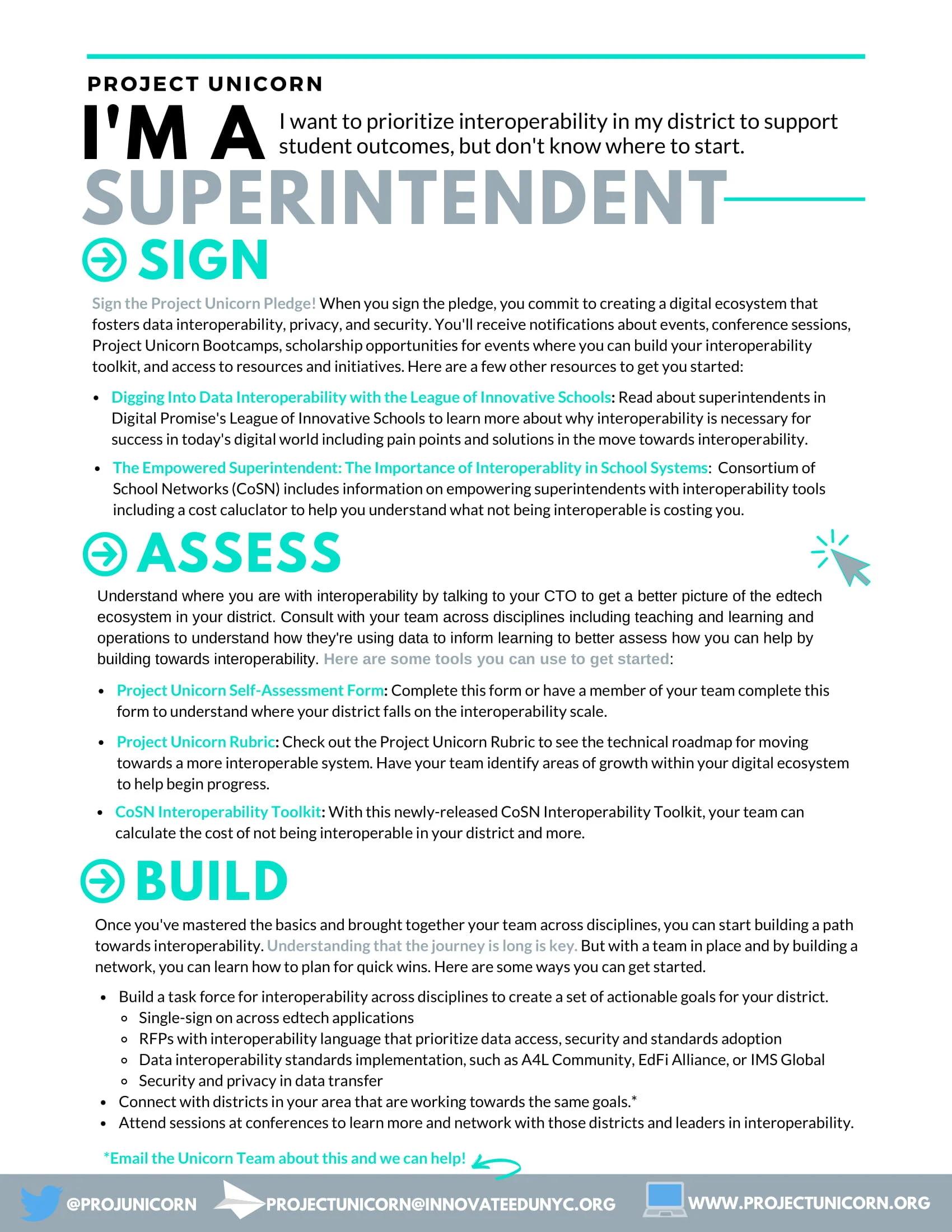
First 3 Steps for Superintendents
Learn more about starting your journey towards interoperability as a superintendent.

State Strategies to Develop Teacher Capacity for Personalized, Competency-Based Learning
This issue brief shares state policy recommendations and action steps for policymakers who are supporting the redesign of educator workforce systems.
Ecosystem Empowerment Guide by A4L
This guide has been developed with input from CIOs/CTOs and is meant to address both data management and data privacy which are two major concerns that schools face each day.

EdSurge Research Guide in Interoperability
In this guide, you’ll find case studies from the perspective of educators and administrators, as well as a series of profiles that share how companies are thinking, planning and guiding their product development process to address these user needs.

Chief Privacy Officers: Who They Are and Why We Need Them
From the Center for Democracy and Technology, read this resource to learn more about the role of Chief Privacy Officer and why they are important to district teams.

SEND (Smart Education Networks by Design)
The Smart Education Networks by Design (SEND) Initiative by CoSN provides districts with resources to help them navigate the shift from old networks to modern, resilient, flexible networks that support the increasing demands of teaching and learning.

Roadmap to Safeguarding Student Data
Understand why safeguarding student data is at the core of interoperability and learn from actionable steps to achieve it.

Centralized vs. Distributed Educational Solution Architectures – Data Confederacies Compared to Data Unions
Compare and Contrast: Multi-tier Educational Data Sharing Architectures