
Featured Resources
-
2026 Quarter 1 AI & Interoperability Brief Release
Interoperability is foundational to AI success in education, and building an underlying structure grounded in data standards and data maturity is key to implementing AI that will truly benefit schools and students.
The 2026 Quarterly AI and Interoperability Brief Series explores the intersection of interoperability and AI, highlighting the latest trends, case studies, and tools you can use to improve your educational technology ecosystem.
-
Currently, the lack of standardized, national definitions for core service terms creates a systemic ‘transfer gap.’ This lack of clarity often results in significant delays for students waiting to receive comparable services in a new district. To address this, researchers convened an expert panel to establish a much-needed consensus on these terms.
-
AI Data Use and Protection - Worksheet
In the rush to adopt an AI tool, don’t let data security become an afterthought. The AI Data Use and Protection Worksheet is designed to help cross-functional leaders—from the CISO to General Counsel—a clear, standardized vetting process.
This worksheet allows teams to create a side-by-side risk matrix for every vendor, allowing them to make a safe, confident, and informed decision before entering a vendor agreement.
-
Considerations for the School Districts in Considering Large Scale AI Model Deals
As Artificial Intelligence (AI) and frontier AI models rapidly reshape the educational landscape, school systems face a dual challenge: harnessing these tools' transformative potential while rigorously safeguarding student data, privacy, and well-being. Procurement is no longer just about purchasing; along with AI literacy, it is the first line of defense in responsible AI governance.
The following slide deck is available for consideration and understanding.
-
Considerations for the School Districts in Considering Large Scale AI Model Deals
As Artificial Intelligence (AI) and frontier AI models rapidly reshape the educational landscape, school systems face a dual challenge: harnessing these tools' transformative potential while rigorously safeguarding student data, privacy, and well-being. Procurement is no longer just about purchasing; along with AI literacy, it is the first line of defense in responsible AI governance.
For years, Project Unicorn has championed the need for data to flow seamlessly and securely between systems to inform instruction and operations. Simultaneously, the EDSAFE AI Alliance has led the global charge on the SAFE (Safety, Accountability, Fairness, and Efficacy) benchmarks for AI adoption in education.
Now, as "frontier models"—highly capable, large-scale AI systems—enter our schools, these two missions must converge. Procurement is the intersection where safety meets connectivity.
We developed this resource to bridge the gap between technical data governance and ethical AI implementation, responding to practical needs from our work leading 29 school district policy labs and 10 state policy labs. These questions are designed to help district and state leadership vet tools not just for what they can do, but for how they fit into a secure, interoperable, and learner-centered ecosystem. Whether you are evaluating a standalone AI app or integrating a large-scale frontier model, this guide can be part of your blueprint for responsible innovation.
Resource Database

LER Series: Standards & Protocols That Ensure Credential Interoperability and Portability
LERs are comprehensive digital records that capture academic achievements, professional licenses, certifications, and even informal experiences. These records are dynamic and offer a holistic view of an individual's skills and accomplishments, aiding them in their educational and career journeys.
This resource covers credential creation & issuance, interoperability, secure sharing, and data privacy.

LER Series: A State's Perspective on Policy and Data Interoperability
Focusing on data interoperability, particularly within the state policy context, provides significant opportunities for individuals to benefit from access to their own information and for state systems to serve residents through program improvement better. However, policymakers should keep in mind that other issues must remain a priority if they are to realize these outcomes. Data privacy and security, particularly in the K-12 space, must be considered alongside the advancement of technology solutions.

LER Basics: Standards that Ensure Interoperability and Enable Lifelong Learning
LER stands for Learning and Employment Record. It refers to a collection of digital records that document an individual's learning experiences, skills, and achievements acquired both inside and outside of traditional academic settings. LERs provide a comprehensive snapshot of a person's educational journey, including academic transcripts, professional certifications, licenses, and informal learning experiences such as volunteer work or internships. The goal of LERs is to offer a dynamic and comprehensive tool for individuals to showcase their skills and achievements as they pursue opportunities in education and the workforce.
What is an API?
An Application Programming Interface, or API, connects your data from different applications and helps facilitate interoperability between edtech providers and district systems. It’s vital for school districts to understand what an API is and how it works to modernize data infrastructure to create safe ecosystems for student data. This understanding will enable districts to ask the right questions when procuring and implementing edtech software. Learn more about what an API is, how this impacts you and your district, and best practices when utilizing APIs with edtech providers!

Why Sign the School Network Pledge?
In our quest to help networks better understand and improve their K12 school system's capabilities, we created the School Network Pledge. This pledge symbolizes secure access to student data, educates practitioners and families about student privacy, promotes equity, and ensures fiscal responsibility for edtech purchases. By signing this pledge, schools are signaling to other school networks, edtech vendors, and their community that they’re committed to helping students grow with interoperability.

Why Sign the Edtech Vendor Pledge?
To support edtech vendors in enhancing the use of educational data and improving teaching and learning practices for stronger student outcomes, we created the Edtech Vendor Interoperability Pledge. This pledge symbolizes the commitment to maximizing equitable access and availability through data interoperability. By signing the pledge, edtech vendors are signaling they are committed to enhancing their products' security, access, privacy, and interoperability. This enables educators, and families to be more involved in their student’s education, enhancing the effectiveness of their educational data. It also informs teaching and learning practices for stronger student outcomes.

SLDS: Envisioning Success with the Modernization of Statewide Longitudinal Data Systems and Federal Funding Policy
A successful and modernized Statewide Longitudinal Data System (SLDS) should function as a dynamic tool empowering educators, principals, and decision-makers to directly impact student outcomes. Beyond the mere collection of data, the system must seamlessly transform information into actionable insights through intuitive dashboards. This evolution from data to information to knowledge to wisdom is crucial for informed decision-making at various educational levels.

SLDS: Federal Funding Braiding to Support Data-Driven Instruction Work
Ready to uncover recommendations, resources, and success stories to enhance your journey to harness the full potential of SLDS (Statewide Longitudinal Data Systems)? Dive into Project Unicorns’s latest resource and learn how to use the strategy of federal funding braiding to secure federal funding sources and improve your implementation.

Stories From the Field
Stories from the Field, curated by Project Unicorn, provide a glimpse into the collaborative efforts between school systems and edtech solution providers, offering valuable insights into what's possible within an interoperable data ecosystem in education. These stories supplement the findings from the 2023 State of the Sector (SOTS) Report, offering a detailed analysis of K-12 school system capabilities related to education data, with input from 208 unique LEAs, Regional Education Service Agencies, and school systems. Explore Stories from the Field and the SOTS report to better understand the evolving landscape of education data.

SLDS: Using Cooperative Strategies for State Capacity Building and R&D Infrastructure
The potential of cooperatives to build capacity for implementing Statewide Longitudinal Data Systems (SLDS) is vast. With the ability to foster interagency cooperation and strengthen the data ecosystem, this strategy presents an innovative approach. This resource provides suggestions and examples of incorporating cooperatives into your SLDS initiative. Learn about the key benefits, anticipate challenges, and explore recommendations for state leaders.

SLDS Basics: Ensuring Interoperability
Statewide Longitudinal Data Systems (SLDS) can be crucial in education data management and data-driven decision-making. Some states have increasingly looked to make these connections to workforce development, such as California’s Cradle to Career system. These systems are designed to collect, store, analyze, and manage a wide range of data related to student performance, school information, demographics, and other relevant indicators in the education data curriculum. To ensure effective use and meaningful data analysis, interoperability is a key consideration in SLDS implementation.

K-12 Digital Infrastructure Briefs
As we work to provide physical infrastructure for our schools that is safe, healthy, and supportive for all students, the time has come to align resources towards creating a digital infrastructure that is equally safe, accessible, resilient, sustainable, and future-proof.

Privacy Jump-Start Guide
Protecting student data privacy is critical to implementing interoperable technology systems. Read this jump-start guide to learn about key education data privacy organizations and resources that support best practices in student data privacy during your interoperability journey.

Better Edtech Buying: A Practical Guide - Revised Edition
To provide more insight and guidance into how edtech purchasing happens and consider how educators and leaders can work together to make more informed purchasing decisions, the International Society for Technology in Education (ISTE) and Project Unicorn have released Better Edtech Buying: A Practical Guide - Revised Edition.

Why Interoperability Matters for SLDS | Stories from the Field
Data interoperability can make it easier for states to deploy and maintain State Longitudinal Data Systems. Learn how the Indiana Department of Education, North Dakota Department of Public Instruction, South Carolina Department of Education, and Texas Education Agency are leveraging data interoperability to support data-based decision-making at the federal, state, district, and local levels.
Privacy, Security, Interoperability
Why One Supports the Other: Data interoperability is a helpful component to building and maintaining quality software. Interoperability isn't a panacea, but making intentional and informed choices about implementing an interoperability standard contribute to better development practice, better privacy practice, and better security practice. Here are 5 ways interoperability, privacy, and security enhance each other.

CoSN Resource: An Introduction to Interoperability Standards for Education Leaders
With the explosive growth of digital resources to support both instruction and business decision making, more K-12 staff know how to use technology — and value the use of data to inform practice. Yet many express concern that they are “data rich and information poor,” which makes integrating, analyzing, and applying data a key challenge. Educational leaders who can harness the growing data generated in their districts can be empowered to transform both instructional and business practices.

Data Integrator List
Data integration platforms, products and services can help school systems seamlessly and securely bring together previously siloed education data, supporting advanced data analytics and reporting. This can help educators make better decisions to support students and save school systems time and money. Peruse our list of integration specialists to find the right provider and solutions for you!

Standards Glossary V2
The Standards Glossary by Project Unicorn is a directory that contains a list of Interoperability Standards in K-12.
First Three Steps for K-12 IT Leaders
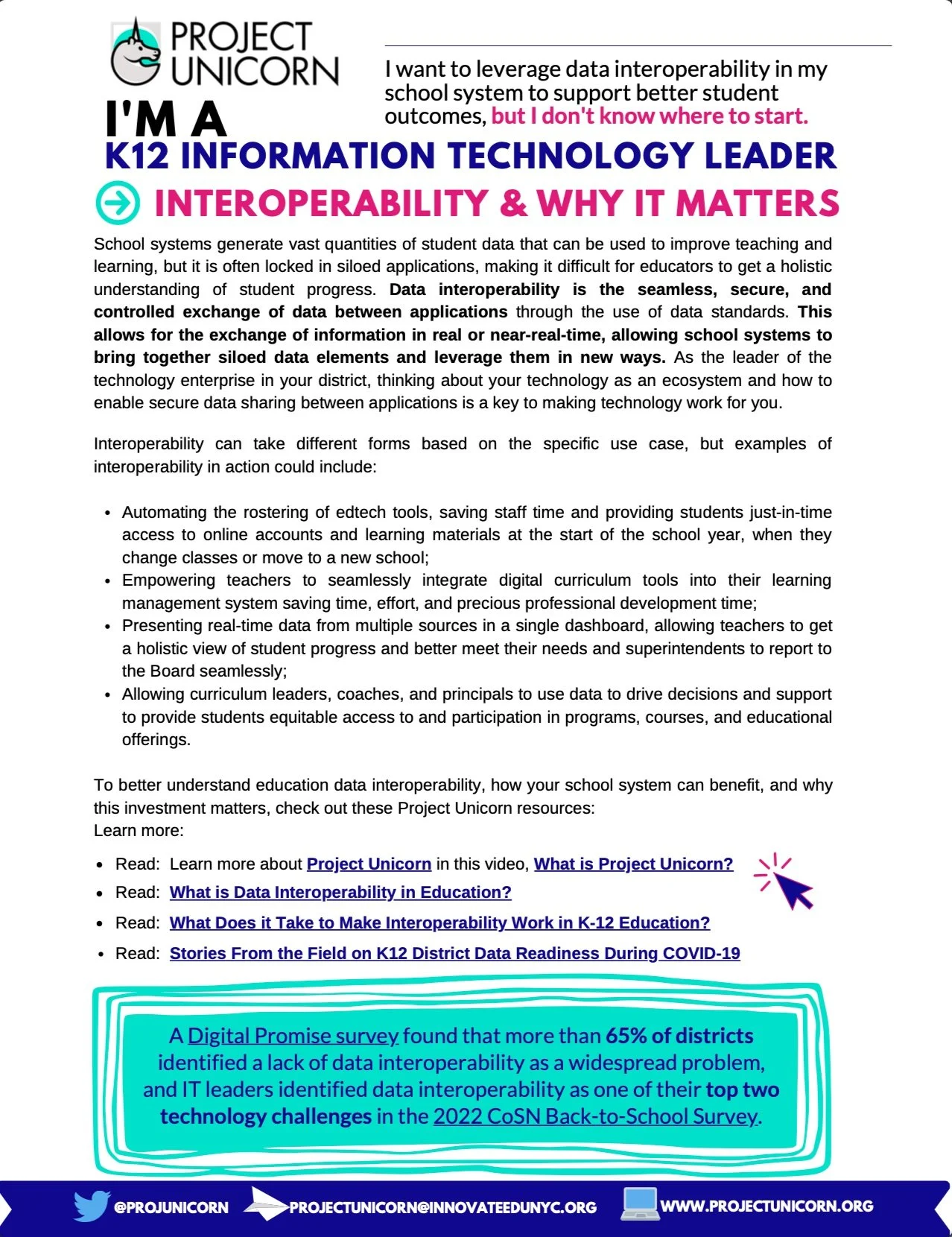
Student data can be used to improve teaching and learning, but the vast quantities of data is often locked in siloed applications that make it difficult for educators to get a holistic understanding of student progress. Data interoperability can help your school system unlock this siloed data and better support student outcomes. Review the First 3 Steps for K12 Information Technology Leaders to learn more about the first steps IT leaders can take to leverage their school system’s data!